Destroyer of Jobs, Creator of Better Ones
"The great AI displacement is here."
"AI impacting labor market 'like a tsunami'"
"Gen Z faces 'job-pocalypse', as global firms prioritise AI over new hires"

A quick google on job displacement serves up all kinds of horror. Scary stuff, mainly because it's easy to believe. LLMs and the products built on them have been improving exponentially, and have without a shadow of a doubt become equal to and even surpassed humans in all types of tasks. As a result, people have started using LLMs to help them with all kinds of stuff on a daily basis, and are recognizing that something big is happening. This sentiment of AI job displacement is not new though. I've heard it many a time in the past when people, during my studies in AI, jokingly asked me whether I was going to 'replace' them. "Destroyer of jobs, creator of better ones" I always replied, a self-description of Vitalik Buterin that has stuck with me. Admittedly, partly because I used to be an Ethereum fanboy. But also because it's such a lovely and simple response to kill all discussion on the matter. Bertha Benz's first test drive had horse breeders lose their jobs, but created opportunity for manufacturers and fuel suppliers. The mechanical loom displaced handweavers, but gave rise to factory workers and machine operators. There used to be literal computers — people doing math and computing outcomes — but on came roles like software engineers and UX designers. AI fits right in, right? Right!? Even though we have historical examples of technology furthering society as a whole, the reality is that Vitalik's wisdom might miss some nuance. There's unfortunately more to job displacement than 'those frontend designers or call center agents will find something else'. In this write-up, I'll delve into what's real and what's not, and focus on what we can do to deal with this supposed destroyer of jobs, AI. Of course, like in the previous part of this trilogy, written in a Europe-first perspective.
Let's start with debunking the headlines at the beginning of this article. They are generally nothing more than speculative nonsense. Macro-level labour market data has not been showing any significant increase in job displacement, neither in the EU nor the U.S., let alone that we can attribute it to AI. Yes, big software companies have been laying off junior developers, and yes, LLMs will likely take over some of that work. But that doesn't mean they caused those layoffs in the first place. Moreover, these layoffs have been mostly a U.S. phenomenon, and could in my opinion better be explained as the result of the macroeconomic problems over there. Let's not forget corona happened, and the fact that in economic peril junior roles are the first that get cut. These layoffs have also not been happening in the rest of the western world, and if they were purely attributable to AI, why would the U.S. be the only one affected? Evidence from more than 12,000 European firms shows that adopting AI increases productivity by around 4 percent on average, with no immediate employment losses. To add some personal experience: I work in tech for agriculture and one thing I keep hearing from distributors and growers is that finding people is just inherently tough. They are always understaffed. I mean to say, let's not forget there are many places we have huge gaps to fill, meaning that automation won't result in replacement, but just helping fewer people be overworked and increasing productivity as a whole.
Enjoying this article? Subscribe to get my new articles and scientific research delivered to your inbox.
Nevertheless, there will always be sectors where displacement is on the horizon, and we should take this seriously. According to IMF estimates, up to 40% of jobs in advanced economies could be affected by AI. For context, the 2008 financial crisis cost Europe around six million jobs, which was roughly 3% of total employment. I'm also experiencing major changes firsthand in my work at OneThird. I recently charged an intern to only write code using agentic LLMs, pitching it as 'you don't have to be able to write frontend code yourself anymore'. I now regularly spar about the product design choices I make, sometimes flat-out picking one recommended by Claude. I'm making a product which is replacing visual defect analysis of fresh produce, and am doing so while having all types of agents write logic for me. In other words, I'm actively outsourcing work to AI that might otherwise have been done by new full-time colleagues. Additionally, even when technology does create new jobs, as mentioned in the introduction of this article, the people who lost the old ones often aren't the ones who get them. Remember those horse breeders, handweavers, and human computers? Those transitions played out over decades, and they still devastated communities that weren't prepared. Northern England and the Ruhr Valley saw entire generations struggle through deindustrialization. Keep in mind that AI will be integrated much quicker, and people will have much less time to adapt as well. And while I don't think we should point to AI as the cause of job displacement at this point, just looking at how I automate most of my software work myself now, there is no getting around it that we are in for something big. So what should we do? There are plenty of possibilities.
Firstly, let's take inspiration from our friends (can I still call them that?) in the land of the free (can I still call it that?). Anthropic recently posted a great write-up on AI and job displacement. Mostly, they reiterate the points I made above. They acknowledge that there is, as of yet, no systematic increase in unemployment and that classifying jobs as 'vulnerable' has often gone awry in the past. Nevertheless, they go on to define a metric called "observed exposure". This boils down to a combination of theoretical AI capability with real-world usage data from Claude to identify which occupations are actually being affected. They claim that they will periodically update this measure as new data comes in, building an early-warning system rather than a one-off prediction. I think we should build something like this in Europe too, because unlike the U.S., we actually have a great number of institutions to take action if the warning light goes on.
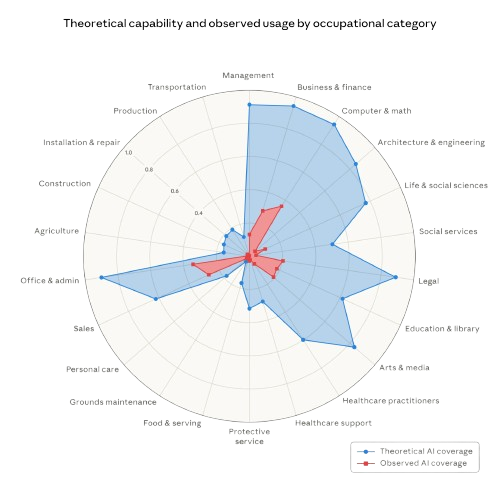
In Europe, we take a fundamentally different approach from the U.S. with respect to job displacement. Whereas they treat the job market as, well... just a market, we try to gauge how well our social institutions hold up. We have the luxury of being able to look beyond 'X people lost their jobs' and actually understand what happens to those people, because we have the institutions to act on it. Yes, it is bureaucratic, and yes perhaps a route such as national employment agencies → national statistics offices → Eurofound → Cedefop is cumbersome, but it's a pipeline that actually connects detection to action. So let's use it. Let's build AI displacement monitoring into this framework, the way Anthropic is doing for the U.S., and let's fund the instruments that sit at the end of that pipeline. Take the European Globalisation Adjustment Fund (EGF): since 2007 it has supported over 180,000 displaced workers across 186 cases, and according to Commission data, 81% of recipients found new employment within 18 months. It works. And yet its annual budget for 2021–2027 is a whopping €35 million. For a continent staring down 50–60 million jobs exposed to AI-driven change, that is not a serious number.
Another thing we can get ready in advance is how to go about reskilling. If AI were to massively take over tasks, reskilling efforts should not focus exclusively on being able to use AI effectively. We have various institutions, like ARISA, focusing on this now. I think it is more important to reschool workers to focus on broader competencies that are more resilient to future disruptions caused by AI, to be able to actually make use of the time it saves us. The gaps are enormous: according to the latest EURES report, Germany alone faces deficits in over 160 occupations, with an estimated 600,000 unfilled blue-collar vacancies. The Netherlands, Belgium, and Malta have the highest job vacancy rates in the EU. We need nurses, plumbers, electricians, and welders, so let's get people to be able to do those jobs. The European Qualifications Framework exists on paper, but cross-border mobility for reskilled workers remains painfully slow. The Commission launched its Union of Skills package in 2025 to tackle this, which lists measures like a Skills Portability Initiative, a pilot European diploma, and a Skills Guarantee for workers at risk of unemployment. These types of initiatives need to get some more American-esque pacing behind them: we need them now.
To me it's clear: Europe has the tools to handle a possible wave of job displacement. Things are changing quickly though, and unlike with social media and deepfakes, let's not wait until shit hits the fan. If you've made it this far, I hope I've convinced you of two things: the headlines screaming about an AI job apocalypse are premature, but the underlying shift could be very real. Don't panic, but do vote, push, and advocate for the kind of policy that only Europe is positioned to deliver.
Want to get notified when I post something new? .